


















Best Glasses for Night Driving: What Actually Works (and What Doesn't)

Reviewed by
Neggie Saadatpay-Wright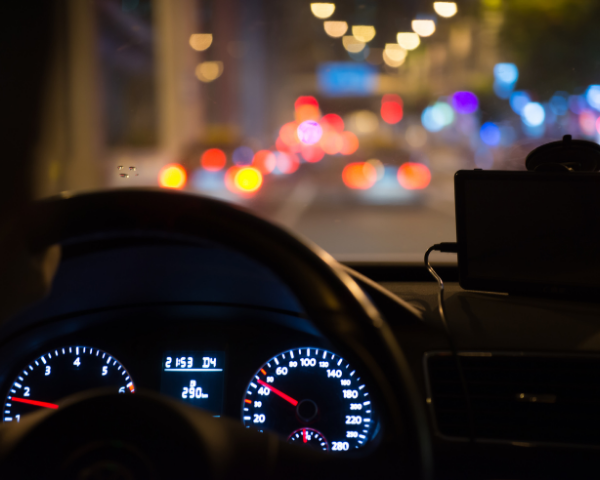
Overview
What you need | Why it helps |
|---|---|
Up-to-date prescription | Even mild uncorrected errors blur vision at night |
Anti-reflective (AR) coating | Reduces glare from headlights and streetlights on your lenses |
zFort coating | Filters some blue light, which may help reduce light scattering from headlights and streetlights |
Clear lenses (not tinted) | Maximum light transmission in low-light conditions |
Astigmatism correction | Eliminates the starburst/streak effect around lights |
Progressive lenses (40+) | Smooth focus between road, mirrors, and dashboard |
Why night driving is so hard on your eyes
Your eyes work very differently in the dark. As light drops, your pupils dilate to let in as much as possible, becoming far more sensitive to sudden bright light. That’s why a flash of oncoming headlights can feel blinding even when you know it’s coming.
The challenges pile up fast: oncoming traffic, streetlights, wet road reflections, and even rain and fog make it worse by scattering light in every direction.
If you’re already dealing with a lens prescription that isn’t quite right — or no correction at all — the visual noise becomes overwhelming.
What type of glasses actually help with night vision?
Anti-reflective coating: the real solution
An anti-reflective (AR) coating, also called an anti-glare coating, is one of the most effective lens upgrades for night driving.
It reduces the reflections that form on the surface of your lenses when light hits them at an angle.
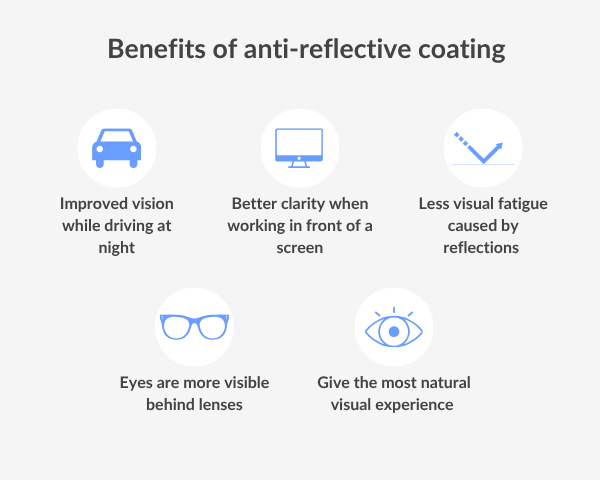
With a quality AR coating, you see more clearly, with less scatter and with less eye strain on long drives.
Photochromic lenses
Standard photochromic lenses (those that darken outdoors) are primarily a daytime tool. However, some advanced varieties are designed to offer light glare reduction in varying light conditions and can help people who are particularly sensitive to headlight glare.
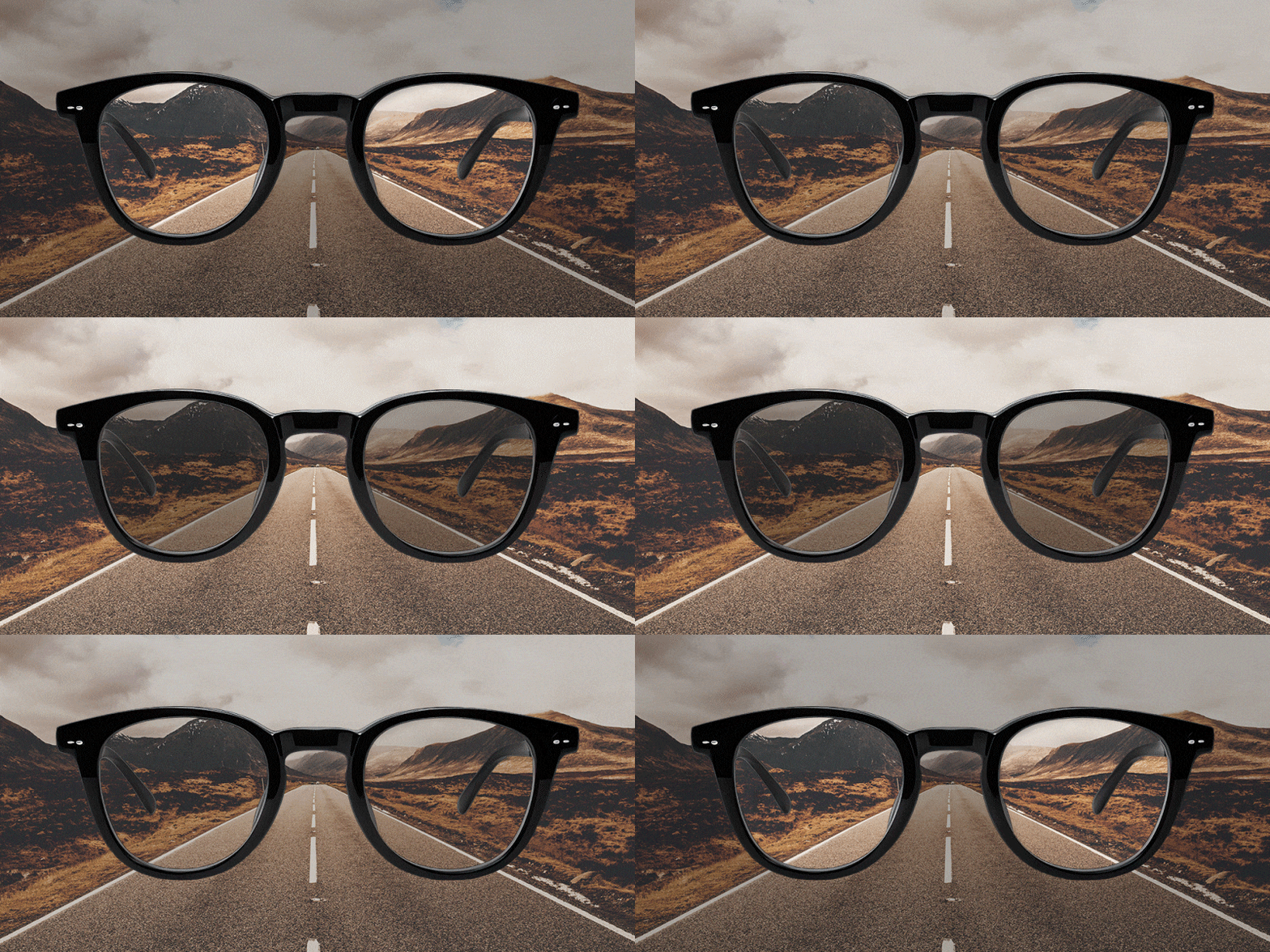
They’re best suited to drivers who want one pair of glasses that works across different times of day rather than glasses specifically for night driving.
Blue light filtering: for in-car screen glare
Modern cars are full of screens. Sat navs, digital dashboards and mounted phones all emit high-energy blue light that contributes to eye strain during long drives.
A blue light filter on your lenses helps here — reducing digital screen fatigue without affecting how you see the road. For best results, combine a blue light filter with your anti-reflective coating.
What to avoid when driving at night
Polarised lenses: good for day, not night
Polarised lenses are excellent at cutting road glare during the day, making them a strong choice for daytime driving. But at night, they reduce the total amount of light reaching your eyes, which is the last thing you want.
They can also interfere with digital displays like sat navs and certain instrument panels. Stick to clear AR-coated lenses after dark.
Yellow-tinted lenses: false sense of clarity
The association of yellow-tinted lenses with night driving is a common misconception, as multiple studies show that they do not improve visual performance at night, and can actually reduce overall light transmission.
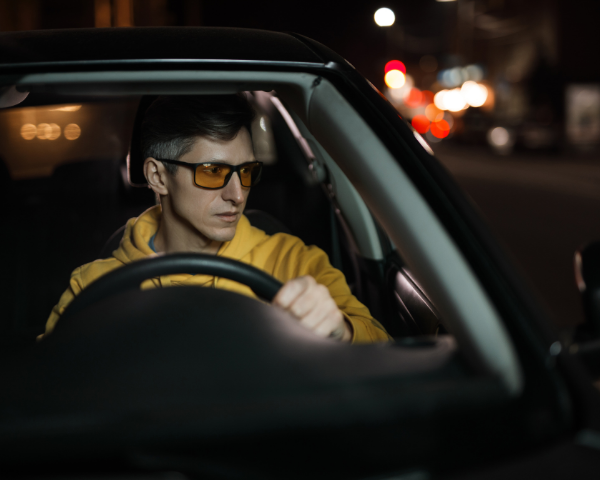
By reducing glare and making headlights and streetlights appear dimmer, they provide a sense of comfortability. However, as a result, seeing pedestrians and traffic lights can be more difficult.
It’s important to keep in mind that feeling better and seeing better are two different things.
How your prescription affects night vision
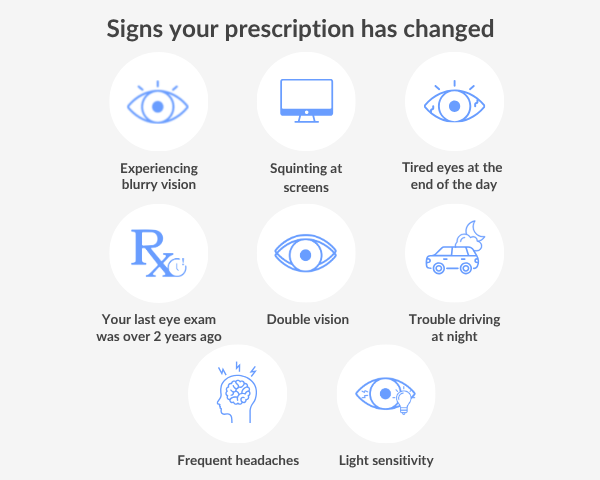
Uncorrected refractive error (myopia and hyperopia): Even a mild, uncorrected prescription causes blur and halo effects at night. Vision may seem acceptable during the day but become noticeably less clear at night. Many drivers don’t realise how much their night vision would improve with an up-to-date prescription until they actually get one.
Astigmatism: Astigmatism is one of the most common causes of night driving difficulties. Astigmatism causes incoming light to scatter instead of focusing cleanly, which creates the characteristic starbursts and streaks around lights. It’s often mild enough to ignore during the day, but at night — when pupils are dilated and headlights can appear blurred or distorted — uncorrected astigmatism makes driving genuinely unpleasant.
Presbyopia: As you age, your eyes gradually lose the ability to shift focus quickly between different distances. Driving demands exactly this: reading a road sign, glancing at the rear-view mirror, checking the dashboard speed and refocusing on the road ahead.If you’ve started noticing that you need to tilt your head or squint to read your dashboard, presbyopia may already be affecting your driving. This is where progressive lenses become important.
EXPERT'S TIP!
“If headlights seem brighter than they used to or halos around lights have become more noticeable, don’t assume it’s just ageing. Night vision often deteriorates gradually, and even small prescription changes can make a surprisingly big difference to comfort and clarity after dark. It’s worth getting your vision checked regularly.”
Neggie Saadatpay-Wright
Can I buy glasses for night driving online?
Yes, and it’s easier than most people expect.
Whether you need prescription lenses or just want a quality non-prescription pair, you can order online in a few minutes with the right information to hand.
Many of the lenses we offer at SmartBuyGlasses include anti-reflective coating, making it easy to choose lenses suited to night driving.
If you’re ordering with a prescription for the first time, our complete guide to buying glasses online walks you through everything, from reading your prescription to getting your pupillary distance right.

When glasses alone aren't the answer
For most people, the combination of an accurate prescription and quality AR coating resolves night driving discomfort significantly. But it’s worth knowing the signs that something more than glasses is going on.
Cataracts cause a progressive increase in glare and halo sensitivity — the kind where headlights seem to have a large, blinding glow that no prescription change quite fixes. This is common from middle age onwards, and treatment through surgery is one of the most routine and effective procedures in modern medicine.
Retinitis pigmentosa causes progressive narrowing of the visual field, often starting with difficulty in low light. It’s less common, but worth discussing with your optometrist or ophthalmologist if your peripheral vision feels restricted at night.
Vitamin A deficiency is an uncommon cause of true night blindness (nyctalopia) in otherwise healthy adults, but worth considering if night vision difficulty appears suddenly alongside other symptoms.
If your night vision problems persist after getting an up-to-date prescription and quality lenses, see your optometrist rather than continuing to experiment with glasses. Some causes of night vision difficulty need clinical assessment, not a new pair of frames.
The bottom line
Night driving is hard on everyone’s eyes. But for most drivers, the solution is often straightforward — it’s an up-to-date prescription and anti-reflective coating on clear lenses.
Skip the yellow-tinted glasses, get your eyes tested if it’s been a while, and make sure your lenses are working with your vision rather than adding to the noise.
If you’re over 40 and finding it harder to balance the road ahead with mirror and dashboard checks, a pair of driving-optimised progressives can make a noticeable difference.
Frequently asked questions
Do yellow glasses help with night driving?
While yellow-tinted lenses may provide the feeling of comfort by making streetlights feel dimmer by reducing overall light transmission, studies consistently show they do not improve vision performance at night.
What is the best lens coating for night driving?
An anti-reflective (AR) coating is the most effective optical upgrade for night driving. It reduces glare and reflections on the lens surface, allowing almost 100% of visible light through to your eye. Combined with an accurate prescription, it can make a significant difference to night-time visual comfort.
Can astigmatism cause problems with night driving?
Yes. Astigmatism is one of the most common causes of the starburst and streak effects you see around headlights at night. These symptoms are often mild enough to ignore during the day but become much more noticeable after dark when your pupils are dilated. Correcting astigmatism with the right prescription makes a significant difference.
Are polarised lenses good for night driving?
No. Polarised lenses are great for reducing glare during the day, particularly on wet roads, but they reduce light transmission — which is a problem at night when you need maximum visibility. They can also interfere with digital dashboard displays. Stick to clear lenses with AR coating after dark.
Do I need a prescription to get glasses for night driving?
Not necessarily. If you don’t need vision correction and you’re finding headlight glare uncomfortable, non-prescription lenses with an anti-reflective coating can help. However, if your vision is even slightly blurry at night, a prescription is likely making the problem worse — it’s worth getting an eye test before assuming glasses aren’t the answer.